Posts

Showing posts from April, 2013

What We Learned This Semester

It is the final week of classes so it is my turn to write the blog post—unfortunately it will be the last post until January 2014.   I will continue this blog the next time the course is offered. This is the first time that I have taught this course by myself.   Recently someone said that a teacher should ask “what have they learned?” rather than “what have I taught?”   This class is definitely a good class to ask the first question since I don’t think that I have really taught my students anything.   However, I am fairly certain that they have learned lots of things.   So, with their permission, here are their answers to the question, “what have they learned in Math 371?” From Leanne Holdorf: Of all my classes this semester, Math 371 is by far my favorite. I was able to dabble in technology that I didn't think I'd have access to for a while. We explored different programs and applications that will help me as a teacher. And I really started t...
Joining the Network

As I sit here typing on the mini iPad provided by the math department for the semester, I have begun to realize just how easy it is to join the network with one tap by my finger. Of course, the World Wide Web is not my only network. As teachers, we are privy to an incredible amount of resources by just being who we are! From having classes with peers in the same education program to being members of national clubs such as the National Education Association, we have a network more valuable than many of us really understand until much later in our careers. To really put this into perspective, a few weeks ago on an online program, I was able to have a conversation about flipped instruction, one-to-one schools, and Common Core with a high school math teacher in California. As a soon to be teacher, I was eager to hear what he had to share about his many years of teaching. Not only did I learn from him but he learned from me! The network and flow of information does not only go from older ...

Society's view on math

I read the article “Mathematics Education: A Way Forward” by David Wees, , http://www.edutopia.org/blog/mathematics-real-world-curriculum-david-wees and it started with the equation:   Population × Bad curriculum   Multiple generations   = Functionally innumerate population. Which is such a true statement, that we don’t always think about. The adult population, of American as well as Canada, has a generally bad experience with math. Not only was it a boring subject in school, they were also told by their parents that it is okay to hate math . I believe that it is critical that we realize that as a society Americans don’t like math, as future and current math teachers we need to foster an environment where it is easy to like math. Though this article is about Canadian math education, I think it applies to American math education as well. This article focuses on three ways to make math more enjoyable and beneficial to society. The three ways are: changing the curric...

Because the Math Gods Say It Is So!

Image
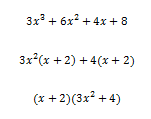
     So often, students evaluate problems by following the steps their secondary Math teachers told them to follow, but never actually realize why they are doing it. I am guilty of doing this. Last week, I was tutoring a student on factoring by grouping, and I just realized what we are really doing when we factor. For example, when you are given the following equation: We look at the first two terms and factor out the GCF (greatest common factor). Then we do the same process for the last two terms. Now, the (x+2) becomes a factor and then the remaining terms become the other factor of (3x^2+4). That is how we got the last line, but what I realized last week was that we actually factor out the GCF again. This time the GCF is (x+2) and then (3x^2+4) is what is left after you factor out the GCF, and this is how you get your two factors by grouping. I never realized that we were actually just factoring out the GCF again. I just always thought if the two ( ) were the same ...