Posts

What We Learned This Semester

It is the final week of classes so it is my turn to write the blog post—unfortunately it will be the last post until January 2014.   I will continue this blog the next time the course is offered. This is the first time that I have taught this course by myself.   Recently someone said that a teacher should ask “what have they learned?” rather than “what have I taught?”   This class is definitely a good class to ask the first question since I don’t think that I have really taught my students anything.   However, I am fairly certain that they have learned lots of things.   So, with their permission, here are their answers to the question, “what have they learned in Math 371?” From Leanne Holdorf: Of all my classes this semester, Math 371 is by far my favorite. I was able to dabble in technology that I didn't think I'd have access to for a while. We explored different programs and applications that will help me as a teacher. And I really started t...
Joining the Network

As I sit here typing on the mini iPad provided by the math department for the semester, I have begun to realize just how easy it is to join the network with one tap by my finger. Of course, the World Wide Web is not my only network. As teachers, we are privy to an incredible amount of resources by just being who we are! From having classes with peers in the same education program to being members of national clubs such as the National Education Association, we have a network more valuable than many of us really understand until much later in our careers. To really put this into perspective, a few weeks ago on an online program, I was able to have a conversation about flipped instruction, one-to-one schools, and Common Core with a high school math teacher in California. As a soon to be teacher, I was eager to hear what he had to share about his many years of teaching. Not only did I learn from him but he learned from me! The network and flow of information does not only go from older ...

Society's view on math

I read the article “Mathematics Education: A Way Forward” by David Wees, , http://www.edutopia.org/blog/mathematics-real-world-curriculum-david-wees and it started with the equation:   Population × Bad curriculum   Multiple generations   = Functionally innumerate population. Which is such a true statement, that we don’t always think about. The adult population, of American as well as Canada, has a generally bad experience with math. Not only was it a boring subject in school, they were also told by their parents that it is okay to hate math . I believe that it is critical that we realize that as a society Americans don’t like math, as future and current math teachers we need to foster an environment where it is easy to like math. Though this article is about Canadian math education, I think it applies to American math education as well. This article focuses on three ways to make math more enjoyable and beneficial to society. The three ways are: changing the curric...

Because the Math Gods Say It Is So!

Image
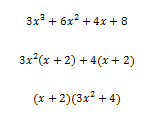
     So often, students evaluate problems by following the steps their secondary Math teachers told them to follow, but never actually realize why they are doing it. I am guilty of doing this. Last week, I was tutoring a student on factoring by grouping, and I just realized what we are really doing when we factor. For example, when you are given the following equation: We look at the first two terms and factor out the GCF (greatest common factor). Then we do the same process for the last two terms. Now, the (x+2) becomes a factor and then the remaining terms become the other factor of (3x^2+4). That is how we got the last line, but what I realized last week was that we actually factor out the GCF again. This time the GCF is (x+2) and then (3x^2+4) is what is left after you factor out the GCF, and this is how you get your two factors by grouping. I never realized that we were actually just factoring out the GCF again. I just always thought if the two ( ) were the same ...

Don't Be Afraid To Fail / Be a Learner

As a future teacher, I constantly have the same thoughts reappear in my head. "Should I use this technology or that technology?" "Which app is best for this task?" "What activity would be best for this lesson?"  Seriously, how do you really know?  I have finally come to the realization that at some point you simply have to let loose and go with what you feel.  Yes, it is important as a teacher to do your research to make sure you don't pick a "dud" app or do an activity that doesn't apply to the lesson.  I am simply saying that I am not going to exhaust my time finding out every little detail. I am already dreading the first year I actually start teaching.  I know that my 8 hour school day will turn into a 12+ hour work day.  That's just the simple fact of being a first year teacher (or any teacher).  Thus, my time needs to be spent on preparing the lesson and not debating on how to teach it.  With that said, I can expect to fail.  ...

MOOCS: Massive Open Online Courses

MOOCS have become increasingly popular over the years.  I think these courses resemble flipped instruction in the way that they are lectures online.  The students can access them whenever they want and can watch the lecture numerous times so they can understand the material.  This can be extremely helpful for some students.  There can be as many as 15,000 students enrolled in one class learning from one teacher.  They may be able to contact each other and help each other with the material.  To me, Khan Academy is similar to MOOCS also, except that it is not a class.  It provides students with videos that run through examples in many classes in science and math.  Also, MOOCS=$FREE.  How can any college student go wrong with that?  With the rising costs of college tuition, students look for any way to get anything for free.  I know I would take a MOOC, if they actually counted for college credit.  I believe some college students ...

Educational Technology: Leveling the Playing Field

Throughout this course and throughout this blog, we have identified several reasons why technology should be used in a math classroom. These reasons have been anything from increasing student engagement, to more individualized education, to the availability of millions of different educational tools in the palm of your hand. All of these reasons highlight the overwhelming positives of having technology in the classroom. However, I really think if I had to sum it all up into one reason, I would say that educational technology levels the playing field. What I mean when I say that it levels the playing field is that it allows all parties involved to have the same opportunities of anyone else in education. This includes students, teachers, parents, administrators, and the general public. I will go into more depth on some of these. The most important of all the people educational technology affects is, of course, the students. Educational technology has opened new doors to coun...